

If you have watched competitive skiing you know what I am talking about. Racers spend from more to less time in a tuck from downhill races to slalom. The more and tighter turning required means less time tucking and more time in a more upright position.
Now, what does a good tuck look like? Read on!
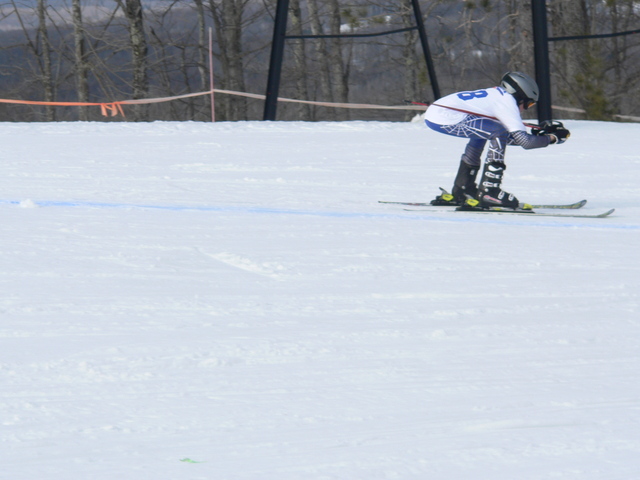
I do have one suggestion for the above skier to improve their tuck. I do not have scientifically established data to support my claims, but it makes a big difference I can feel.
At Blackjack the run they call Shanty Girl has a steep initial headwall, followed by a long flat section (flat is relative, but it is very flat even for a green run), and then finishes with another steep drop to the chair. Problem with the run is that flat, because wind resistance will decelerate you quite significantly (air resistance is stronger the faster you are going). So, when I ski this run I usually assume the tuck posture in the flat section.
In the photo above the skier’s tuck is pretty good except for his arms. I have found, that thrusting your arms straight ahead in front of you with you hands touching each other straight in front of your head seems is the least resistant to the air. Of course, I may have caught him as he is starting in his turn sequence.
When I ski NASTAR after the first gate I tuck. From that point, I attempt to maintain that stance as much as possible, but turning is easier when accompanied by a more vertically elongated stance. Certainly when I have cleared the last gate I am in a tight tuck and pushing out straight ahead with my arms.


2 Trackbacks / Pingbacks